

Power supplies are the least exciting part of a gaming PC. Nobody posts their PSU on social media. But pick the wrong one and your shiny new graphics card can switch the whole PC off in the middle of a boss fight, which is a very exciting way to learn the lesson.
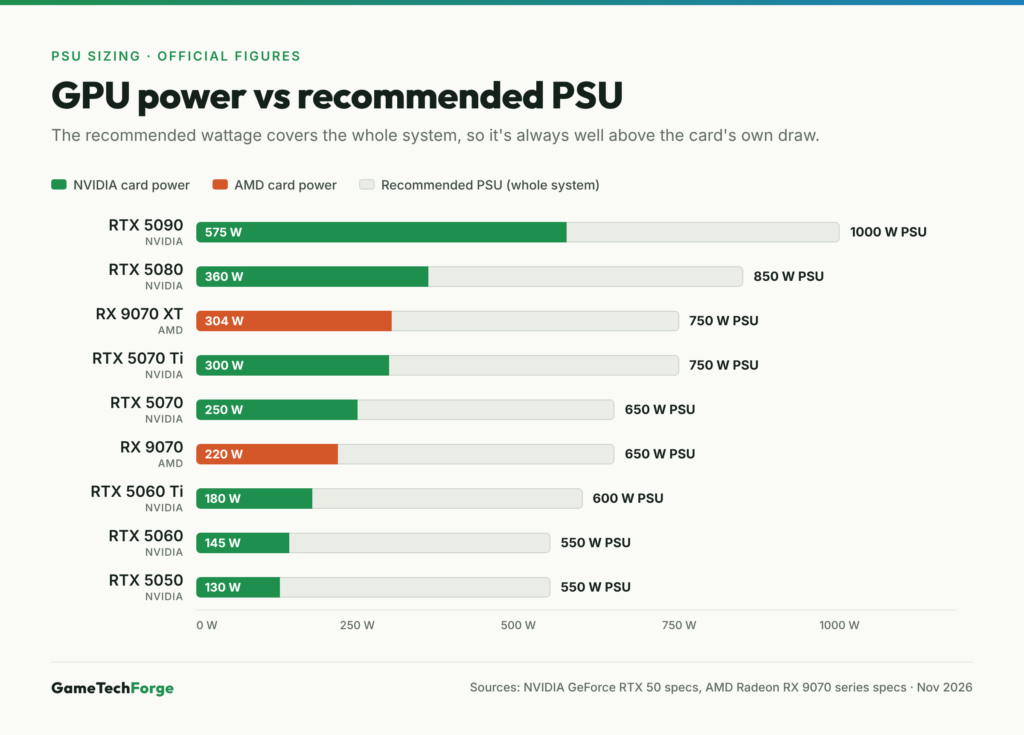
The easiest rule is to trust the graphics card maker. NVIDIA and AMD both publish a recommended power supply size for every card. That’s 650 watts for an RTX 5070 or RX 9070, 750 watts for an RTX 5070 Ti or RX 9070 XT, 850 watts for an RTX 5080 and 1000 watts for an RTX 5090. Those numbers already include room for a normal gaming CPU and the rest of the PC, so most people don’t need to add anything on top. Spend your money on a good quality unit at that size rather than a bigger, cheaper one.

The official numbers
Here’s every card in one place. “Card power” is how much the graphics card itself can draw. NVIDIA calls it total graphics power and AMD calls it total board power.
| Graphics card | Card power | Recommended PSU |
|---|---|---|
| RTX 5090 | 575 W | 1000 W |
| RTX 5080 | 360 W | 850 W |
| RTX 5070 Ti | 300 W | 750 W |
| RX 9070 XT | 304 W | 750 W |
| RTX 5070 | 250 W | 650 W |
| RX 9070 | 220 W | 650 W |
| RTX 5060 Ti | 180 W | 600 W |
| RTX 5060 | 145 W | 550 W |
| RTX 5050 | 130 W | 550 W |
The figures come from NVIDIA’s RTX 50 comparison page, Corsair’s RTX 50 guide, AMD’s RX 9070 XT page and AMD’s RX 9000 quick reference guide. Partner cards with factory overclocks can draw more, and sometimes list a bigger PSU on the box, so check the exact card you buy.

Two small mix-ups are worth knowing about. One section of NVIDIA’s own RTX 5070 family page mentions an 850 watt minimum for the RTX 5090 Founders Edition, while its comparison table and Corsair’s guide both say 1000 watts. Go with 1000. Also, the printed RTX 5070 quick start guide asks for a 16-pin cable rated for 360 watts, while the website says 300 watts or more. A 450 or 600 watt 16-pin cable from a modern ATX 3.x power supply covers both, so you don’t need to lose sleep over it.
Why the recommendation is so much bigger than the card
If an RTX 5070 only draws 250 watts, why does NVIDIA ask for a 650 watt power supply? Because the recommendation is for the whole PC, not just the card. It leaves room for a typical gaming CPU, the motherboard, memory, drives and fans. It also adds a safety margin for power spikes, the brief moments when a card suddenly gulps more power than usual.
You can check this yourself with some back-of-the-envelope math. Take the card’s power figure. Add your CPU’s maximum power, which AMD lists as “PPT” and Intel lists as “Maximum Turbo Power”. Add about 100 watts for the motherboard, RAM, drives, fans and USB gadgets. Then add another 30 to 40 percent as headroom.
Let’s try it with an RTX 5070 (250 watts) and a Ryzen 7 9800X3D (162 watts PPT). Add 100 watts for everything else and you get 512 watts. Add 30 percent and you land at about 665 watts, which is right next to NVIDIA’s 650 watt recommendation. A 750 watt unit gives you a bit more breathing room and usually runs a little quieter.

When to go bigger
There are a few good reasons to step up one size. Maybe you have a power-hungry CPU, like a 16-core Ryzen 9 or a top Intel Core Ultra 9, and you work it hard for long stretches. Maybe your graphics card is a factory-overclocked model with a higher power limit than the standard one. Maybe you plan to upgrade your graphics card while you still own this power supply, which is quite likely, since a good unit often lasts 7 to 10 years. Or maybe you just like a quiet PC. Power supplies tend to be quietest and most efficient when they’re running at around 40 to 60 percent of their maximum.
When a smaller one is fine
If your CPU is a modest 65 watt chip (a Ryzen 5 9600 non-X, for example) and your card is a standard RTX 5060 or 5060 Ti, a good 550 to 650 watt unit is plenty. We wouldn’t go below the graphics card maker’s recommendation, though. If the power supply trips its safety protection during a spike, the PC simply shuts off mid-game, and no amount of saved money feels worth it at that moment.
What matters more than the number of watts

Quality beats size. A well-reviewed 750 watt power supply from a reputable maker is a better buy than a no-name 1000 watt one. Check independent reviews and PSU tier lists before you buy.
For an RTX 50 card, look for an ATX 3.0 or 3.1 power supply with a native 16-pin cable (you’ll see it called 12V-2×6). Corsair points out that the 50 series only needs a single one of these cables, and having a native cable means you can skip the bulky adapter.
And when you plug that 16-pin cable in, push it all the way home and don’t bend it sharply right next to the plug. It’s the PC building version of making sure the fridge door is properly shut.
How we researched this guide: the graphics card power figures come from NVIDIA’s GeForce RTX 50 comparison table and RTX 5070 quick start guide, Corsair’s RTX 50 guide, AMD’s RX 9070 XT product page and AMD’s RX 9000 quick reference guide, all checked on November 27, 2026. Partner cards can differ, so always check your specific model.

